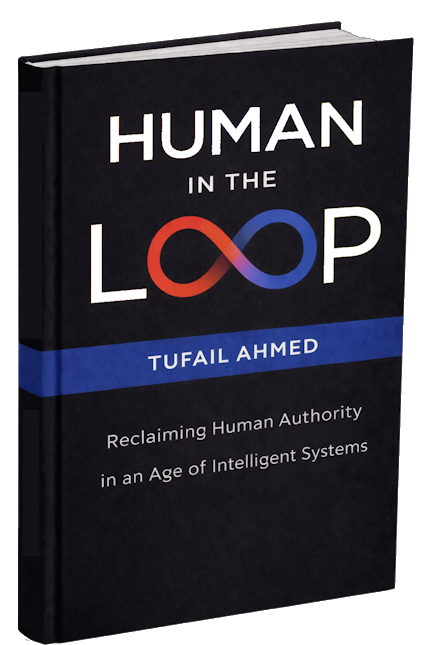
Authored Book
Human in the Loop
Reclaiming Human Authority in an Age of Intelligent Systems
This is not a book about slowing down AI. It is a blueprint for the leaders, organisations, and nations who believe that technology should amplify human potential — not replace it. Drawing on 20+ years of enterprise AI and public-sector transformation experience, it makes the operational and philosophical case for keeping humans meaningfully in control of consequential decisions.
What the book argues
AI that operates without human oversight isn't advanced.
It's ungoverned.
As artificial intelligence embeds itself into decisions about finance, healthcare, security, and governance, the question of accountability becomes urgent. When an AI system makes a consequential decision — or assists in one — who is responsible for the outcome?
Human in the Loop argues that the answer cannot be "the algorithm." It examines how organisations can scale AI capability while keeping human judgment structurally embedded in the systems that matter most — not as a limitation, but as a design principle that makes AI more trustworthy, more adaptable, and ultimately more effective.
The book is written for leaders who are past the hype — who are already deploying AI and now face the harder questions: How do we govern this responsibly? How do we preserve accountability at scale? How do we build AI that our institutions, our people, and our citizens can trust?
Inside the book
Core arguments, chapter by chapter.
The Illusion of Full Automation
Why greater automation doesn't mean greater accountability — and how diffused responsibility quietly erodes institutional trust.
What Human-in-the-Loop Really Means
A design-first definition: clear ownership, defined escalation paths, explainable behaviour, and context-aware human intervention.
Governance as a Design Problem
Governance cannot be retrofitted. It must be architected into AI systems from day one, alongside data models and infrastructure.
AI Sovereignty & National Strategy
How nations can build AI capability that reflects their values, culture, and long-term strategic interests — not just adopt technology built elsewhere.
Reclaiming Human Authority
The future of AI belongs not to fully autonomous systems, but to thoughtfully governed ones that scale human judgment — not replace it.
Who it's for
Written for decision-makers, not data scientists.
Executive leaders
Building AI strategy and needing a governance framework that actually works at scale
Government & policy
Designing national AI programs that balance capability with sovereignty and accountability
Technology leaders
Deploying AI systems and grappling with the human and institutional side of the equation
Board members
Overseeing organisations where AI decisions carry regulatory, reputational, and ethical weight
"AI should scale human judgment, not substitute it."
— Syed Tufail Ahmed